Top Navigation
  • Home
  • About Us
    • Our Story
    • Our Team
    • Mission and Vision
  • Donate
    • Why Donate
    • Payment Methods
Main Navigation
  • News
    • Local
    • National
    • International
  • Development
  • Environment
    • Weather
    • Climate
    • Conservation
    • Biodiversity
    • Natural Disasters
    • Pollution & Waste
    • Energy
    • Ecology
  • Opinion
    • Expert Views
    • Editorials
    • Guest Articles
    • Youth Voices
  • Business
  • Technology
  • Profiles
  • Travels
  • Initiatives
    • Climate Education
    • Policies & Agreements
    • Resources
  • More
    • Events
    • Lifestyle
    • Multimedia
    • Research/Reports
    • Publications
  • Home
  • About Us
    • Our Story
    • Our Team
    • Mission and Vision
  • Donate
    • Why Donate
    • Payment Methods
Sustainable Development Goals Sustainable Development Goals
  • News
    • Local
    • National
    • International
  • Development
  • Environment
    • Weather
    • Climate
    • Conservation
    • Biodiversity
    • Natural Disasters
    • Pollution & Waste
    • Energy
    • Ecology
  • Opinion
    • Expert Views
    • Editorials
    • Guest Articles
    • Youth Voices
  • Business
  • Technology
  • Profiles
  • Travels
  • Initiatives
    • Climate Education
    • Policies & Agreements
    • Resources
  • More
    • Events
    • Lifestyle
    • Multimedia
    • Research/Reports
    • Publications
Search Here
Editorials
  • Home
  • Editorials
  • EV Fires: Understanding the Battery Risk Without Losing Sight of the Clean-Transport Transition
EV Fires: Understanding the Battery Risk Without Losing Sight of the Clean-Transport Transition
Ganesh Khatiwada
Ganesh Khatiwada 2026-09-15 11:54:00

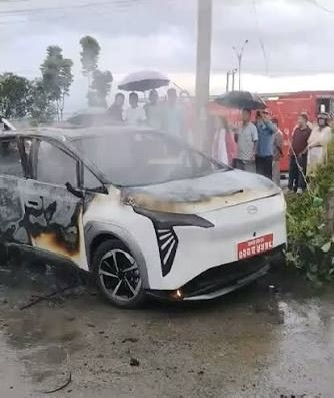
KATHMANDU, September 15, 2026 - Electric vehicles are rapidly transforming transport in Nepal and around the world, offering an important pathway to reduce dependence on imported fossil fuels and, where electricity comes from low-carbon sources, cut transport emissions. But a recent fatal electric-vehicle fire in Bharatpur has also raised an important public-safety question: why can an EV catch fire, and how should such incidents be prevented and managed?

The answer begins with the battery.

Most modern electric vehicles use lithium-ion battery packs made up of thousands of interconnected cells. Under abnormal conditions, a cell can experience thermal runaway-an uncontrolled chemical reaction in which heat is generated faster than it can be dissipated. Heat from one failing cell can spread to neighbouring cells, potentially causing thermal propagation, intense heat, flammable-gas release, smoke and fire.

Thermal runaway can have several possible triggers. These include an internal manufacturing defect or short circuit, severe physical damage to the battery following a collision, electrical faults, overheating, or problems associated with charging equipment. Battery-management systems and thermal-management systems are designed to detect and control abnormal conditions, but no technology eliminates risk entirely.

Nepal's Bharatpur case highlights the need for evidence, not speculation

The death of a 55-year-old man after his electric car caught fire while travelling on the East-West Highway near Bharatpur has understandably generated concern in Nepal. However, investigators have not yet established that the battery caused the fire.

Nepal's recent experience shows why this distinction matters. A 2024 MG EV fire in Budhanilkantha was attributed after technical investigation to a short circuit involving the charging cable and socket, while the vehicle's high-voltage battery remained undamaged. In a 2025 BYD Atto 3 fire in Morang, technical inspections reportedly found the battery and high-voltage powertrain intact, with external combustible material identified as the probable source.

The Bharatpur investigation therefore needs to establish whether the origin was the traction battery, charging system, collision or another electrical or mechanical failure before conclusions are drawn.

EV fires are different-not necessarily more common

It is important not to confuse fire severity with fire frequency.

Available evidence does not support the simplistic claim that electric vehicles are inherently more likely to catch fire than petrol or diesel vehicles. Norway's Directorate for Civil Protection and Emergency Planning, for example, says research has found no basis for claiming that EVs present a greater fire danger than fossil-fuel vehicles; rather, EV fires can behave differently.

The particular challenge is the battery's stored chemical energy. Once thermal runaway begins, a damaged lithium-ion battery can continue producing heat and flammable gases, and reignition can remain a concern. US safety authorities therefore treat damaged or flooded EVs as a special emergency-response issue.

A lesson for Nepal's rapidly expanding EV market

Nepal's geography makes battery safety especially important. Vehicles regularly travel through steep mountain roads, rough terrain and flood-prone corridors. Recent monsoon disasters have also demonstrated how vehicles can be exposed to deep water, debris and severe impacts.

A flood-damaged EV should not simply be restarted or parked inside a home or enclosed garage. US vehicle-safety guidance warns that water-damaged high-voltage batteries can present shock and fire hazards, including the possibility of delayed fire.

Nepal therefore needs stronger systems for EV safety: independent battery and vehicle testing, transparent recall mechanisms, qualified charging infrastructure, trained technicians and firefighters, emergency-response protocols, post-crash battery inspections and reliable national data on EV-related incidents.

Charging infrastructure also deserves particular attention. Safe charging requires properly installed equipment, undamaged cables and connectors, appropriate electrical protection and compliance with manufacturer recommendations.

Safety must strengthen-not undermine-the clean-energy transition

The lesson from EV fires should not be that Nepal should abandon electric mobility. It should be that clean transportation must also be safe transportation.

Nepal has a strategic opportunity to build an electric-mobility system around its abundant renewable electricity while learning from international experience. But public confidence will depend on transparent investigations whenever an EV fire occurs, accurate statistics, stronger regulation and professional emergency response.

The future of electric mobility should not be a choice between climate action and safety. Nepal can-and must-deliver both.

Ecosphere News believes that responsible environmental journalism requires separating legitimate technological risks from misinformation, while ensuring that public safety, consumer protection and the clean-energy transition advance together.EV-1789452758.jpeg
#EcosphereNews #ElectricVehicles #EVSafety #EVFire #ThermalRunaway #BatterySafety #ElectricMobility #CleanTransport #CleanEnergy #ClimateAction #SustainableTransport #Nepal #NepalEV #RoadSafety #FireSafety #BatteryTechnology #RenewableEnergy #SustainableDevelopment #ClimateResilience


Published Date 2026-09-15 11:54:00
Comments
More Editorials
Nepal’s Himalayan Flood Disaster Raises a Global Climate Justice Question: Who Will Pay for the Loss and Rebuild a More Resilient Himalaya?
Nepal’s Himalayan Flood Disaster Raises a Global Climate Justice Question: Who Will Pay for the Loss and Rebuild a More Resilient Himalaya? 2026-09-08 07:38:00
Super El Niño Looms: A Warming Planet Braces for a Turbulent 2026-27
Super El Niño Looms: A Warming Planet Braces for a Turbulent 2026-27 2026-08-25 10:19:00
Kathmandu Valley Moves Toward Human-Centric Urban Mobility Vision
Kathmandu Valley Moves Toward Human-Centric Urban Mobility Vision 2026-08-06 10:24:00
Nepal PM Performance Review: Reform Push Wins Public Support, but Political and Institutional Challenges Persist
Nepal PM Performance Review: Reform Push Wins Public Support, but Political and Institutional Challenges Persist 2026-08-03 08:37:00
Nepal’s Wild Tiger Population Reaches 429, Marking a Historic Conservation Milestone
Nepal’s Wild Tiger Population Reaches 429, Marking a Historic Conservation Milestone 2026-07-29 11:50:26
Calls Grow for Review of Crowd-Control Practices Following Fatal Protest Shootings in Nepal
Calls Grow for Review of Crowd-Control Practices Following Fatal Protest Shootings in Nepal 2026-07-27 11:49:00
Most Loved
  • Week
  • Month
Argentina’s ‘Vanishing Sea’ Was a Rare Extreme Low Tide, Not a Global Catastrophe
Australia’s Fossil-Fuel Exports, Global Warming and Nepal’s Himalayan Disaster: Who Bears the Cost?
Strong El Niño Raises Flood Risk Across Greater Horn of Africa as Region Moves Toward Early Action
Nepal’s Himalayan Flood Disaster Raises a Global Climate Justice Question: Who Will Pay for the Loss and Rebuild a More Resilient Himalaya?
Environmental Sustainability at a Crossroads: Global Challenges Demand Urgent Action
Argentina’s ‘Vanishing Sea’ Was a Rare Extreme Low Tide, Not a Global Catastrophe
Rasuwa Flood: What Really Happened, the Human Cost, Destruction and the Road Ahead
Mustang Climate Conference to Amplify Himalayan Voices on the Global Stage
Australia’s Fossil-Fuel Exports, Global Warming and Nepal’s Himalayan Disaster: Who Bears the Cost?
Can Scientists Predict When Glaciers Will Collapse? Nepal’s Himalayan Disaster Raises Urgent Questions About Early Warning Systems
Contact Us

News Desk

Ecosphere News
Chakupat, Lalitpur, Nepal
Phone : +977-01-5400646
Email: [email protected] www.ecospherenews.com

Sales & Marketing

Email: [email protected]
Cell Phone: 9820631466 / 9767470774
Media Details
Publisher Ecosphere News and Travels Pvt. Ltd.
DOIB Registration No. 4699-2081/2082
Editor Ganesh Khatiwada
Follow us on Twiitter

Nature’s Healing Touch: Summer River Swim Brings Peace and Joy https://t.co/J2GfWcNdj0

— Ecosphere News (@EcosphereNews) March 20, 2026
Like us on Facebook
© 2026 Ecosphere News Environmental & Developmental Issues. All Rights Reserved. Site by: SoftNEP

SoftNEP News Alert

अख्तियार स्वतन्त्र निकाय भएकाले वाइडबडि छानबिनमा अहिलेसम्‍म कुनै किसिमको राजनीतिक दबाब आएको छैन।स्वतन्त्र ढंगले काम गरिरहेका छौ।
सदस्यता लिनुहोस्