Kathmandu, Nepal - The Government of Nepal has unveiled a budget of NPR 2.124 trillion for the upcoming fiscal year, prioritizing infrastructure development, energy expansion, education, health, agriculture and social security programs.
Presenting the budget at the joint meeting of the Federal Parliament, Finance Minister Dr. Swarnim Wagle stated that NPR 1.270 trillion, equivalent to 59.8 percent of the total allocation, has been set aside for recurrent expenditure. Likewise, NPR 431.10 billion has been allocated for capital expenditure and NPR 422.64 billion for financial management.
The government has announced significant investments in road and transport infrastructure. The East-West Highway has received the highest allocation of NPR 37.46 billion, followed by NPR 17.64 billion for the Terai-Madhes Expressway. Other major allocations include NPR 6.55 billion for the Prithvi Highway, NPR 4.65 billion for the Hulaki Highway, NPR 2.16 billion for the Pushpalal Mid-Hill Highway and NPR 1 billion for the Karnali Highway.
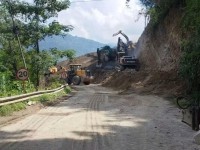
The budget has also prioritized road maintenance, bridge construction and road safety. NPR 28.52 billion has been allocated for nationwide road maintenance campaigns, while NPR 5.14 billion has been earmarked for suspension bridge construction and NPR 2.46 billion for road safety improvement programs.
In the energy sector, the government has allocated NPR 85.54 billion for electricity generation, transmission and distribution infrastructure. An additional NPR 70 billion has been set aside for transmission lines and substations, reflecting Nepal’s continued emphasis on hydropower and energy expansion.
The drinking water and sanitation sector has received NPR 37.17 billion, including NPR 7.26 billion for expansion of drinking water pipelines in Kathmandu Valley and NPR 3.46 billion for wastewater treatment center construction in Kathmandu.
Education remains one of the highest-funded sectors, with NPR 218.30 billion allocated overall. The budget includes NPR 8.60 billion for student scholarships and NPR 1 billion for infrastructure mapping of community schools. The health sector has received NPR 101.95 billion, including NPR 15 billion for the national health insurance program and NPR 13.15 billion for health and social security programs targeting economically vulnerable citizens.
Agriculture and irrigation have also received major attention in the budget. NPR 46.92 billion has been allocated for agriculture and livestock development, while NPR 32.46 billion has been set aside for chemical fertilizer procurement. Several major irrigation projects, including the Rajapur Irrigation/Bheri Babai Diversion Project, Sikta Irrigation Project and Sunkoshi-Marin Diversion Project, have also secured multi-billion-rupee allocations.
Similarly, NPR 12.31 billion has been allocated for the forest, environment and climate sector, reflecting growing concerns over environmental conservation and climate resilience. The government has also announced NPR 4.19 billion for urban greenery promotion in major cities.
The tourism and aviation sectors have received notable allocations as well. NPR 7.34 billion has been earmarked for culture and tourism, while NPR 1.53 billion has been allocated for the upgrading of Tribhuvan International Airport.
The newly announced budget indicates the government’s continued focus on infrastructure modernization, social welfare expansion, energy development and economic growth amid ongoing economic and development challenges facing the country.
#NepalBudget #Budget2026 #NepalEconomy #InfrastructureDevelopment #EnergySector #Education #HealthSector #Agriculture #Tourism #ClimateAction #EcosphereNews #Nepal