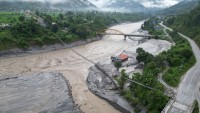
Chitwan, April 18, 2026 - In a country highly vulnerable to natural disasters, Nepal’s frontline rescuers continue to demonstrate extraordinary courage and commitment. From floods and landslides to road accidents and fires, personnel trained under the Disaster Management Training School of the Armed Police Force Nepal (APF) in Kurinatar are playing a crucial role in saving lives-often at significant personal risk.
Operating in high-stakes environments, these rescuers-including divers, firefighters, and emergency responders-embody a level of dedication rooted in national service. However, the risks they face are real, and not all return unharmed. Their work underscores the urgent need to balance rapid response with the safety and protection of rescue personnel.
Chief District Officer of Chitwan, Ganesh Aryal, acknowledged the institution’s impact, noting that its achievements-despite limited resources-are commendable. He emphasized Nepal’s geographic vulnerability and the importance of strengthening both response capacity and rescuer safety. He further called for the center to be upgraded into a specialized national institution.
Established in 2001 as a base camp, the Kurinatar facility formally began disaster management training in 2010 and evolved into a dedicated training center by 2011. Since then, it has expanded its reach significantly, establishing 59 temporary disaster management bases across the country. These decentralized units enhance rapid response, particularly in remote and high-risk regions.
According to APF Assistant Spokesperson Shailendra Thapa, efforts are underway to improve emergency response along the busy Prithvi Highway. A new initiative under a “Road Safety Council” framework aims to integrate nearby community hospitals and ambulance services between Naubise and Mugling, ensuring faster rescue and immediate medical care following accidents.
The training center has produced 134 specialized divers and continues to offer a wide range of programs, including Medical First Responder (MFR), Collapsed Structure Search and Rescue (CSSR), rope rescue, and water-based operations. In collaboration with local governments, over 167,000 community-level “disaster informants” have also been mobilized to support early warning, information sharing, and rescue coordination.
Over the past two decades, APF’s disaster management units have rescued 1,007 individuals alive from life-threatening situations. Additionally, more than 15,500 people have been safely rescued, around 88,500 injured individuals assisted, and over 25,700 bodies recovered and handed over to families-highlighting both the scale of disasters and the extent of response efforts in Nepal.
Head of the training center, Bharat Khaniya, stated that the institution is working to further enhance its capacity by producing highly skilled manpower and adopting more specialized training approaches. These efforts aim to make Nepal’s disaster response system more effective, coordinated, and results-oriented.
Echoing this, Chairperson of Sahid Lakhan Rural Municipality, Ramesh Babu Thapa Magar, praised the Armed Police Force’s vital role in disaster response, noting that their contributions in saving lives during emergencies remain unparalleled.
As climate change intensifies the frequency and severity of disasters, Nepal’s investment in trained responders and community-based preparedness signals a critical step toward resilience. Yet, experts stress that sustained funding, institutional strengthening, and safety measures for rescuers must remain a priority to ensure long-term effectiveness.
#EcosphereNews #DisasterManagement #Nepal #ArmedPoliceForce #ClimateResilience #EmergencyResponse #SearchAndRescue #Floods #Landslides #RoadSafety #CommunityPreparedness #RescueHeroes