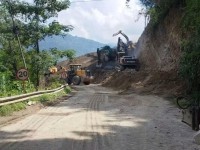
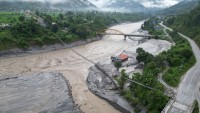
DHADING, Nepal - September 17, 2026: Krishna Bhir, one of Nepal’s most persistent landslide-prone sections along the Prithvi Highway, is once again at the centre of national attention after flood-induced damage severed a major section of the road and disrupted a critical transport and supply corridor to Kathmandu.
Located about 83 kilometres west of Kathmandu in Dhading district, Krishna Bhir has a long history of slope instability. A massive landslide on August 11, 2000 completely blocked the Prithvi Highway for about 11 days, highlighting the vulnerability of the steep geological formation to intense monsoon rainfall, inadequate drainage, erosion and other human-induced pressures.
The site subsequently became a notable example of Nepal’s use of combined civil engineering and bio-engineering for landslide management. Retaining and gabion structures, drainage measures and vegetation-based slope protection were used to control water, erosion and movement of soil and debris. The approach was widely recognised as an important case of applying locally appropriate bio-engineering to a difficult Himalayan road environment.
However, the recent crisis demonstrates that even successful slope-treatment systems require continuous monitoring, maintenance and adaptation. Researchers have noted that weak geology, drainage problems, erosion, mechanical disturbance and inadequate long-term maintenance can gradually reduce the effectiveness of bio-engineering interventions.
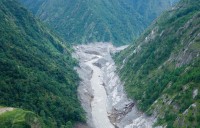
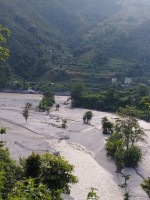
The latest damage was intensified when the Trishuli River eroded the lower section of the highway, washing away a substantial portion of the road and retaining structures. Authorities have since been working around the clock to restore traffic. A new temporary alignment of roughly 300 metres has been cut into the hillside, with the track approaching 7-7.5 metres in width. Test vehicles have already used the route, while drainage, gravelling and slope-cutting works continue. Authorities have indicated September 17 as the target for regular operation, subject to site safety and further landslides.
Yet engineers and geologists caution that the temporary route should not be mistaken for a permanent solution. Reports indicate that cracks and instability remain on the hillside, while experts have urged immediate stabilisation and consideration of longer-term alternatives.
The government is therefore examining more durable engineering options, including soil nailing, piling, stronger slope-protection structures and potentially a tunnel or bridge alignment that could reduce exposure to the unstable Krishna Bhir slope.
For Nepal, Krishna Bhir is more than a landslide site. It is a reminder that climate resilience, geological risk management and national connectivity must be planned together. As extreme rainfall, floods and river erosion increasingly challenge mountain infrastructure, permanent solutions will need to combine sound geotechnical engineering, effective drainage, ecological slope management, regular monitoring and climate-informed infrastructure planning.
The lesson from Krishna Bhir is clear: emergency access can restore a road, but resilient infrastructure must address the landscape that repeatedly threatens it.
#KrishnaBhir #Krishnabhir #PrithviHighway #Dhading #Nepal #Landslide #ClimateResilience #DisasterRiskReduction #Geohazard #BioEngineering #SlopeStabilization #ResilientInfrastructure #TrishuliRiver #HimalayanInfrastructure #ClimateAdaptation #RoadSafety #SustainableDevelopment #EcosphereNews