Kathmandu, Nepal - Continuous rainfall, floods and landslides have disrupted all three major overland trade routes between Nepal and China-Rasuwagadhi, Tatopani and Korala-one after another. Natural disasters have severely affected trade and supply systems through the northern border, highlighting the need for alternative routes for Nepal’s overland trade with China.
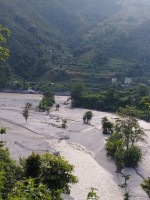
Recently, flooding in the Kaligandaki River washed away the approach roads to several bridges along the Kaligandaki Corridor, disrupting road connectivity to the Korala border point. According to Lalit Jung Khanal, Deputy Director General of the Bridge Branch of the Department of Roads, the floods washed away the approach roads to the Dedhgaun Bridge connecting Tanahun and Nawalparasi, the Maldhunga Bridge, and the bridge connecting Pokharebagar with Bhrung-Tatopani in Myagdi.
The approach road to the concrete bridge connecting Pokharebagar in Ward No. 6 of Annapurna Rural Municipality and Naulibagar of Bhrung-Tatopani in Ward No. 2 was washed away by the Kaligandaki flood. As a result, transportation connectivity with Wards 2, 3 and 4 of Annapurna Rural Municipality, as well as with Mustang, has also been disrupted, according to Rural Municipality Chairperson Bharat Kumar Pun.
Similarly, the approach road to the Maldhunga Bridge connecting Parbat and Baglung has also been damaged by the flood. Traffic has come to a halt after the approach road was damaged. As the bridge, which lies along the national-priority Mid-Hill Highway, has been affected, thousands of daily travelers have been impacted.
Vehicles traveling toward western Nepal through the Maldhunga Bridge, including those heading to Baglung, Myagdi, Mustang, Gulmi, Rolpa, Rukum, Jajarkot and Salyan, have also been affected.
Earlier, the flood in the Bhotekoshi River on Bhadra 10 caused extensive damage to the infrastructure of the Rasuwagadhi border point, forcing the crossing to close. The Tatopani border point, one of the oldest major trade routes between Nepal and China, had already been closed due to landslide risks. Now, with the road leading to Korala also affected, all three major overland trade routes with China have been disrupted simultaneously.
Although some other border points with China remain operational, they do not have the capacity to handle trade volumes comparable to those of Rasuwagadhi, Tatopani and Korala. This situation has exposed Nepal’s dependence on alternative routes and vulnerable infrastructure for its overland trade and supply system with China.
Growing Trade at Korala Also Affected by Road Disruptions
After the Rasuwagadhi and Tatopani border points were disrupted, Korala had increasingly become an important alternative trade route for goods and electric vehicles imported from China.
Between Bhadra 10 and Bhadra 25 alone, 434 containers and 641 electric vehicles entered Nepal through the Korala border point. During the same period, the Mustang Customs Office collected NPR 1.7844 billion in revenue.
From the beginning of the current fiscal year until Bhadra 25, the Korala border point had already generated NPR 2.3144 billion in customs revenue.
Likewise, during fiscal year 2082/83 BS, goods worth NPR 14.41 billion were imported through the Korala border point, while goods worth NPR 205 million were exported. During the same period, 3,223 electric vehicles entered Nepal through the border point.
However, although customs operations at Korala remain in place, damage to roads and bridges at various locations along the Beni-Jomsom-Korala road section has affected the movement of cargo vehicles. This means that even though the border point itself remains operational, road infrastructure has emerged as a major challenge to maintaining regular trade.
Calls for Diplomatic Initiative to Reopen Tatopani
Budh Raj Basnet, president of the Sindhupalchok Chamber of Commerce and Industry, has called on the government to take diplomatic initiatives to reopen the Tatopani border point during the current crisis. According to him, businesspeople will face further difficulties if Korala, which has been operating among the northern border points, is also affected by road disruptions.
He said the government should take initiatives to reopen the Tatopani border point through necessary coordination if it is possible to operate the crossing, as there is no major problem at the border point itself.
Growing Dependence and Risks in Trade with China
During the first two months of the current fiscal year, Nepal’s total foreign trade reached NPR 478 billion. According to the Department of Customs, total foreign trade increased by 35.64 percent compared with the same period of the previous fiscal year.
During this period, Nepal imported goods worth NPR 401 billion and exported goods worth NPR 76.58 billion. Exports during the same period of the previous fiscal year stood at NPR 47.31 billion. On this basis, exports increased by 61.86 percent.
Nepal’s trade deficit reached NPR 324 billion during the first two months, compared with NPR 257 billion during the same period of the previous fiscal year.
India is Nepal’s largest trading partner, followed by China. During the first two months of the current fiscal year, Nepal imported goods worth NPR 76.401 billion from China, while Nepal’s exports to China amounted to only NPR 293.3 million.
With the major overland trade routes between Nepal and China being disrupted one after another, the situation could make it increasingly necessary to bring goods from China through Indian territory as an alternative route.
Natural Disasters Expose Infrastructure Vulnerability
The flood caused extensive damage to trade infrastructure at Rasuwagadhi, while trade through Tatopani has been affected by landslide risks. Although Korala itself has not suffered major direct damage, damage to roads and bridges leading to the border point has affected its operational capacity.
The developments have demonstrated that when one border point is closed, simply shifting trade to another border point is not enough. Roads, bridges and other infrastructure along alternative trade routes must also be adequately secured and made climate-resilient.
As Nepal’s northern trade infrastructure continues to be repeatedly affected by floods, landslides and extreme weather events, there is a growing need for long-term climate-risk assessments, safer roads and bridges, development of alternative trade corridors, and diversification of supply systems among border points.
To maintain regular and sustainable trade between Nepal and China, the immediate restoration of damaged roads and bridges is necessary. At the same time, the situation has once again demonstrated the need for investment in long-term disaster-resilient trade infrastructure capable of withstanding natural hazards.
#EcosphereNews #Nepal #China #NepalChinaTrade #KoralaBorder #Rasuwagadhi #Tatopani #Flood #Landslide #ClimateResilience #DisasterRisk #TradeInfrastructure #KaligandakiCorridor #ClimateChange #NepalTrade #ResilientInfrastructure #SupplyChain