Jomsom, September 17, 2026 - Nepal is seeking to transform the international response to the catastrophic August 26 Himalayan flood from a conventional appeal for humanitarian assistance into a broader demand for climate justice, loss-and-damage finance and accountability for a warming world.
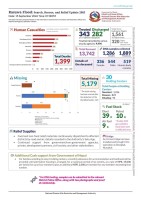
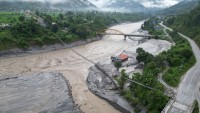
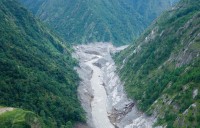
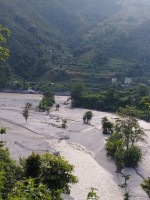
The disaster, which began with a massive rock-and-ice collapse near the Nepal-China border, sent a destructive surge through the Lhende, Bhote Koshi and Trishuli river systems. Current official figures reported by the United Nations put the death toll at more than 1,360, with more than 5,000 people still missing. The human toll and continuing identification of victims have made the catastrophe one of Nepal's most consequential disasters in recent decades.
A mountain disaster with a climate dimension
Scientific assessments indicate that the event was not simply a conventional river flood.
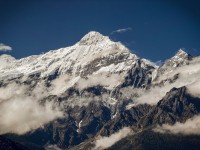
Satellite observations and rapid scientific assessments indicate that glacier ice and underlying bedrock detached at roughly 5,000-5,200 metres on the Lirung massif. The failed material descended into the Lhende catchment, temporarily blocking the river before the accumulated water and debris were released downstream. Early assessments describe the event as a rock-ice avalanche followed by a catastrophic flood.
Scientists are still investigating the precise chain of triggers. An early assessment suggested that an ice avalanche blocked the Lhende River, while other investigations have examined seismic signals, rapid melting and the interaction between unstable ice, rock and river systems. It is therefore important not to present a single trigger as conclusively established before the scientific investigation is complete.
What is increasingly clear is that the disaster occurred in a Himalayan environment experiencing rapid climatic and cryospheric change. Researchers cited by Reuters noted unusually high temperatures and accelerating glacier loss in the region, while the World Bank has long identified Nepal as highly exposed to floods, landslides, glacier-related hazards and other climate impacts.
Nepal's emissions are tiny compared with its climate exposure
Nepal's climate-justice argument rests partly on the enormous disparity between its contribution to global emissions and the risks it faces.
The World Bank estimates that Nepal produces only about 0.1% of global greenhouse-gas emissions. By comparison, 2024 data compiled by Our World in Data show China accounting for about 25.9% of global greenhouse-gas emissions, the United States 11.1% and India 7.8%.
The historical picture is different again. Using cumulative fossil-fuel and industrial CO₂ emissions since 1750, Our World in Data estimates the United States' share at about 23.5%, China at 15.4% and India at 3.6% through 2024. Such figures illustrate why climate negotiations remain deeply contested over the meaning of historical responsibility, current emissions and per-capita equity.
For Nepal, the central diplomatic question is therefore straightforward: how should countries that have contributed relatively little to global warming finance the escalating losses they are experiencing from climate-related hazards?
From aid to loss and damage
Nepal's emerging diplomatic language represents an important shift.
Rather than treating every disaster primarily as a humanitarian emergency requiring donations, the country is increasingly framing climate-related destruction through the international loss-and-damage agenda.
Nepal has reportedly sought US$20 million from the UN-backed Fund for Responding to Loss and Damage, while broader reconstruction and recovery requirements are expected to be substantially larger. The UN has highlighted the extraordinary scale of destruction to roads, schools, electricity infrastructure and water systems caused by the August disaster.
However, there is an important distinction between demanding climate compensation or justice and establishing legal liability against individual countries.
International climate law does not currently provide a simple mechanism through which Nepal can automatically establish that China, India, the United States or another emitter legally owes compensation for a particular flood. Questions of causation, attribution, historical responsibility, state responsibility and financing obligations remain contested internationally.
That distinction makes Nepal's diplomatic argument significant without requiring an assumption that legal liability has already been established.
China, India and the United States occupy different positions
The debate also cannot be reduced to a simple list of “polluters”.
China is currently the world's largest annual greenhouse-gas emitter, while the United States remains the largest historical cumulative contributor in many emissions-accounting frameworks. India is now one of the world's largest annual emitters but has a substantially smaller historical cumulative contribution and lower per-capita emissions than many industrialised countries.
These distinctions are central to global climate diplomacy.
They also explain why Nepal's position could become diplomatically challenging: countries may agree that vulnerable states need greater financial support while disagreeing over whether such support should be characterised as compensation, obligation, solidarity, development finance or voluntary assistance.
The infrastructure bill extends far beyond emergency relief
The August flood did not only destroy homes and communities.
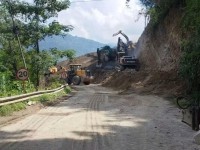
It struck a strategically important Himalayan corridor containing roads, bridges, transmission infrastructure and hydropower facilities. More than a dozen hydropower plants were affected, while the destruction of transport links and electricity infrastructure created consequences extending beyond the immediate disaster zone. India subsequently approved up to 654 MW of electricity exports to Nepal for up to 18 hours a day through December 31, illustrating the wider energy-security consequences of the catastrophe.
For Nepal, reconstruction therefore presents a much larger question than replacing damaged buildings.
The country faces a choice between rebuilding vulnerable infrastructure along historical alignments and using the disaster as an opportunity to redesign roads, bridges, hydropower facilities, settlements and early-warning systems around a new Himalayan risk environment.
A test for global climate finance
The Rasuwa-Bhote Koshi catastrophe is now becoming a test of whether the global climate-finance architecture can respond at the speed demanded by climate disasters.
The Fund for Responding to Loss and Damage, established under the UN climate process, was created precisely because vulnerable countries argued that adaptation and conventional development assistance could not adequately address irreversible losses caused by climate impacts.
Yet the gap between political commitments and money reaching affected communities remains substantial. Recent reporting has highlighted that the loss-and-damage fund had not yet disbursed money to Nepal despite the country's urgent needs.
For Nepal, the message emerging from the Himalayas is therefore broader than a request for emergency assistance.
It is a demand that climate finance become faster, more accessible, more predictable and less debt-producing-and that vulnerable countries have a meaningful voice in determining how that finance is delivered.
From Himalayan tragedy to global climate diplomacy
Nepal's Foreign Minister Shisir Khanal is expected to carry the country's climate and disaster concerns into the international diplomatic arena, with Nepal preparing for high-level UN engagement in September. Khanal assumed the foreign-affairs portfolio in March 2026 under Prime Minister Balendra Shah.
The country's challenge will be to connect the immediate humanitarian catastrophe with a longer-term diplomatic strategy: stronger Himalayan early-warning systems, transboundary disaster cooperation, resilient infrastructure, accessible loss-and-damage finance, scientific monitoring of glaciers and permafrost, and climate finance that does not deepen the debt burden of vulnerable economies.
The August 26 disaster has demonstrated something the Himalayas have been warning about for years: a mountain hazard can rapidly become a national economic crisis and a transboundary humanitarian emergency.
Nepal's emerging climate-justice campaign now asks the international community to confront the other side of that equation: who pays when climate vulnerability is concentrated in countries that contributed comparatively little to the warming that is reshaping their mountains?
That question is unlikely to be resolved by a single compensation claim. But from the valleys of Rasuwa and the Bhote Koshi to the negotiating rooms of the United Nations, Nepal is putting it firmly on the global agenda.
Ecosphere News | Environment • Climate • Development • Sustainability
#EcosphereNews #Nepal #ClimateJustice #LossAndDamage #Himalayas #RasuwaFlood #BhoteKoshi #ClimateChange #GlacierCollapse #HimalayanTsunami #ClimateFinance #ClimateAction #ClimateVulnerability #DisasterRiskReduction #ResilientNepal #GlacialHazards #Hydropower #NepalClimate #GlobalClimateJustice #SustainableDevelopment