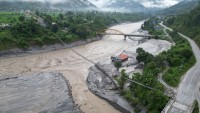
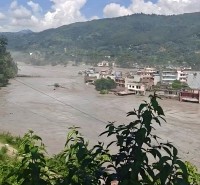
Dhading/Kathmandu - August 30, 2026: The collapse of a major section of the Prithvi Highway at Krishnabhir in Dhading has created a fresh and serious transportation crisis at a time when Nepal is already struggling with the devastating consequences of the ongoing Bhotekoshi disaster.
A section of the strategically vital Muglin-Kathmandu road corridor sank after the swollen Trishuli River eroded the road’s foundation and protective structures, completely halting traffic in both directions. Authorities have begun a technical assessment of the site, while the Department of Roads is expected to determine the repair and reconstruction approach based on the findings.
The Prithvi Highway is one of Nepal's most important transport lifelines, connecting Kathmandu with Pokhara, western Nepal and major supply corridors. Its closure has therefore raised serious concerns over the movement of passengers, essential goods and emergency supplies.
A Preventable Strategic Crisis?
The Krishnabhir area had already been considered vulnerable, and the latest collapse has intensified questions about whether sufficient preventive action and contingency planning were undertaken before the situation reached this critical stage.
The disaster highlights a longstanding weakness in Nepal’s infrastructure planning: major national transport corridors often lack reliable alternative routes capable of immediately handling traffic when a primary highway fails.
This problem has become particularly serious during the current disaster, as other important road networks—including sections of the BP Highway—remain vulnerable or under reconstruction following previous flood damage.
Urgent Need for Alternative Routes
Transportation experts and concerned stakeholders are now calling for the government to urgently examine and operationalise all technically safe alternatives.
For eastern Nepal, priority attention may be required for:
Rapid repair and safe operation of damaged sections of the BP Highway;
Assessment of other available routes connecting Kathmandu with eastern districts and the Terai;
Improved management of the Hetauda-Kulekhani-Kathmandu corridor, wherever technically and safely possible.
For western Nepal, potential alternatives requiring urgent technical assessment include:
Routes from Benighat towards Gorkha, connecting onward to Gorkha headquarters and Abu Khaireni;
Selected sections of the Mid-Hill Highway towards Pokhara and western Nepal;
The possibility of establishing temporary crossings, including Bailey bridges, at suitable and technically safe locations where conventional bridges or road links have been lost.
These proposals should, however, be implemented only after detailed engineering, geological and safety assessments.
Mid-Hill Highway Must Be Treated as a Strategic Alternative
The current crisis has once again demonstrated the strategic importance of completing Nepal's alternative east-west and Kathmandu-connected road networks.
The government should consider placing the completion of critical unfinished sections of the Mid-Hill Highway on an emergency footing. Likewise, bridges washed away or severely damaged by the Trishuli River and associated flooding should be restored as quickly as possible, with temporary Bailey bridges considered where appropriate and technically feasible.
The immediate objective must be clear: Nepal cannot afford to depend excessively on a single vulnerable transport corridor to connect its capital with the rest of the country.
Authorities Must Act Beyond Temporary Repairs
The Krishnabhir collapse should not be viewed merely as another road obstruction requiring temporary patchwork. It is a warning about the growing vulnerability of Nepal's national infrastructure to extreme rainfall, river erosion, landslides and increasingly complex mountain hazards.
As the country confronts the devastating Bhotekoshi disaster and widespread infrastructure losses, the restoration of transport connectivity must be treated as a national emergency.
The concerned authorities must urgently prioritise scientific risk assessment, immediate restoration, safe alternative routes and long-term resilient infrastructure planning.
The question now is not only when Krishnabhir will reopen-but whether Nepal will finally build a transport system capable of surviving the next disaster.
Photo: Road collapse at Krishnabhir, Dhading/Prithvi Highway.
#EcosphereNews #Krishnabhir #PrithviHighway #NepalDisaster #BhotekoshiFlood #Dhading #TransportCrisis #InfrastructureResilience #ClimateRisk #Nepal