Kathmandu/Pokhara: The Government of Nepal has formed a high-level committee to assess the ground reality of land within the legally defined 65-meter buffer zone surrounding Phewa Lake, a Ramsar-listed wetland of international importance. The move comes amid increasing concerns over encroachment, environmental degradation, and the need to enforce judicial directives.
The five-member committee, coordinated by Shiva Prasad Regmi, Director General of the Department of Land Management and Archives, was constituted on Monday by Minister for Land Management, Cooperatives and Poverty Alleviation, Pratibha Rawal. The committee has been given a tight deadline of one week to submit its findings.
Legal Mandate and Environmental Context
The committee has been tasked with reviewing past reports prepared by federal, Gandaki Province, and Pokhara Metropolitan City-level bodies. Its primary objective is to ensure the implementation of the Supreme Court’s mandamus order, which requires the protection of the lake’s ecological boundary based on a 65-meter standard measured from the highest monsoon water level.
Experts have long warned that unregulated urban expansion, tourism infrastructure, and land encroachment around Phewa Lake threaten its ecological balance. As a Ramsar site, the lake holds global significance for biodiversity conservation, water regulation, and local livelihoods.
Key Findings on Land Area
Preliminary data indicate that the demarcated area exceeds previous estimates by 1,213 ropani. The total area, including the lake and the 65-meter buffer zone, has been finalized at 14,570 ropani, 5 aana, and 2 daam. Of this, 2,502 ropani and 5 aana fall within the 65-meter zone excluding the lake itself.
These figures are expected to play a crucial role in determining compensation for affected landowners, once the boundary is legally and scientifically verified.
Demolition Drive Sparks Debate
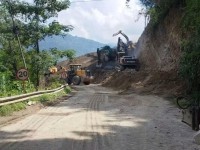
The formation of the committee follows a recent enforcement action by Pokhara Metropolitan City, which demolished 32 structures identified as encroachments within the protected zone. The demolition, carried out using bulldozers, affected properties ranging from small businesses to private residences, including a coffee shop in Sedi and structures linked to local figures.
The action gained further attention after interest was shown by Balendra Shah, reflecting growing political and public concern over environmental governance and urban regulation.
Environmental Significance and Way Forward
The conservation of Phewa Lake is not only a legal obligation but also an environmental necessity. Wetlands like Phewa serve as natural buffers against floods, support aquatic biodiversity, and sustain tourism-driven economies. However, increasing human pressure has led to pollution, sedimentation, and shrinking water boundaries.
The newly formed committee’s report is expected to guide future actions, including fair compensation, stricter enforcement of environmental laws, and long-term conservation strategies. Stakeholders emphasize that balancing development with ecological preservation will be key to ensuring the sustainability of Pokhara’s iconic lake.
#PhewaLake #WetlandConservation #RamsarSite #EnvironmentalProtection #NepalEnvironment #UrbanEncroachment #SustainableDevelopment #Pokhara #ClimateAction #EcosphereNews