Myagdi - The prolonged delay in constructing a motorable bridge at Darkhola in Ward No. 3 of Dhaulagiri Rural Municipality has continued to disrupt daily life for residents of Dar and Mudi, particularly during the monsoon season.
Although a survey for the bridge was conducted four years ago and a Detailed Project Report (DPR) was prepared in the fiscal year 2078/79 (2021/22), the project has yet to move beyond the planning stage due to financial constraints and lack of coordinated budget allocation.
The proposed 25-meter-long motorable bridge is considered vital for ensuring year-round connectivity between Dar, Mudi, Bagar, Naura, Nerawang, Chechung, Khivang, and Khamla settlements and the rural municipality center at Muna. These villages collectively house around 700 families who rely on the route for essential services, trade, and mobility.
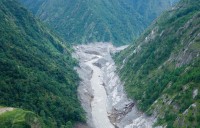
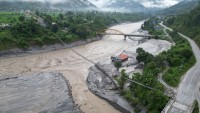
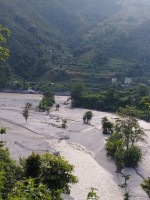
Currently, during the winter season, temporary hume pipes are installed to allow vehicles to cross the stream. However, during the monsoon, floods in Darkhola make vehicular movement impossible from mid-June (Asar) to mid-November (Kartik), effectively isolating communities for nearly five months each year.
Local residents say the absence of a permanent bridge severely impacts food supply, construction activities, emergency medical transport, and the marketing of agricultural and livestock products. Hari Prasad Budha of Dar stated that transporting sick patients to hospitals becomes especially difficult during peak rains, increasing health risks for villagers.
Vishal Gharti, President of the Dhaulagiri Youth Club in Mudi, described the bridge as the community’s primary development demand. According to him, residents have repeatedly raised the issue with candidates visiting the area during the upcoming House of Representatives elections, urging them to prioritize the project.
From the financial perspective, the Gandaki Province Government had allocated Rs 5 million in fiscal year 2080/081 (2023/24) and Rs 3 million in 2081/082 (2024/25). However, political instability and changes in government reportedly hindered the assurance of additional funds required for full implementation.
After the federal government did not include the project in its fiscal year 2082/083 (2025/26) plans, the rural municipality allocated Rs 1.5 million from its own budget, according to Vice Chairperson Resham Pun Magar. The municipality’s policy and program also mention coordination with hydropower projects under construction in the Dar and Mudi areas to potentially build a Bailey bridge.
However, affected residents have opposed the idea of using hydropower projects’ corporate social responsibility funds for bridge construction, arguing that public infrastructure should be financed through government mechanisms. Hydropower developers, on the other hand, are reportedly reluctant to assume additional financial burdens beyond their approved commitments.
Local representatives acknowledge that limited financial capacity at the municipal level has delayed the project. Without multi-tier governmental coordination and clear funding assurance, the Darkhola bridge remains an unresolved infrastructure gap-one that continues to affect mobility, local economies, and emergency access in this remote part of Myagdi.
For residents of Dar and Mudi, the bridge is not merely a development promise but a necessity for safety, economic continuity, and year-round connectivity.
#Myagdi #DhaulagiriRuralMunicipality #DarkholaBridge #InfrastructureGap #RuralConnectivity #GandakiProvince #MonsoonImpact #LocalDevelopment #EcosphereNews