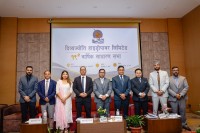
Kathmandu, October 16, 2026 - Nepal’s government has approved a new directive prioritising domestically produced materials and technologies in public procurement and infrastructure development, aiming to reduce reliance on imports, strengthen local industries, and generate employment.
The Council of Ministers approved the Directive on the Promotion and Use of Domestic Products in Public Procurement, 2083, on Ashoj 30, 2083, according to the Office of the Prime Minister and Council of Ministers. The directive establishes provisions to increase the use of Nepali products, locally available resources, and domestic construction technologies in government-funded projects.
Concrete roads prioritised where technically suitable
One of the key provisions concerns road construction. The directive prioritises alternatives to blacktopped roads based on imported bitumen, including concrete roads made with domestically produced cement, locally available stone, and other indigenous construction technologies, wherever technically appropriate.
However, the provision should not be interpreted as a blanket prohibition on all bitumen- or asphalt-based roads. The stated policy is to prioritise suitable domestic alternatives while maintaining the required technical standards.
The approach could create opportunities for Nepal’s cement industry and domestic construction-material producers, while encouraging infrastructure planners to consider locally available resources from the earliest stages of project development.
Domestic materials to receive priority in public buildings
The directive also promotes the use of suitable Nepali construction and finishing materials, including marble, stone, slate, and tiles, instead of imported alternatives such as granite where appropriate.
Domestic products and alternatives are also to be prioritised in building decoration, electrical installations, furniture, and sanitary works.
Public agencies are expected to incorporate domestic products and technologies into feasibility studies, designs, Detailed Project Reports (DPRs), cost estimates, tender documents, and procurement contracts from the outset.
Foreign-brand-specific specifications discouraged
Under the new provisions, government agencies must not prepare technical specifications that exclusively target a particular foreign brand, manufacturing location, or country of origin when suitable domestic alternatives are available.
Domestic products may be used in public projects across Nepal when they are produced or processed from natural resources and raw materials available within the country, provided they meet the applicable requirements.
The directive also requires provisions for domestic materials to be included in tender documents, technical specifications, bills of quantities, and procurement agreements. Where domestic materials are specified in a contract, substituting them with foreign materials requires approval.
Quality and safety remain mandatory
The government has emphasised that promoting domestic products must not come at the expense of quality, safety, durability, or technical compliance.
The directive assigns responsibilities to the heads of public agencies, technical personnel, project-design consultants, and approving officials to help ensure that domestic materials are used as required.
Contractors and suppliers found misrepresenting foreign products as domestic, using counterfeit brands or labels, or providing false information about production locations may face rejection of supplied materials, withholding of payments, blacklisting procedures, and legal action.
Potential implications for Nepal’s economy and environment
The policy is intended to expand markets for domestic producers, increase industrial output, support employment, and reduce dependence on imported construction materials. Its implementation could also encourage greater use of locally available resources and technologies in public infrastructure.
From an environmental perspective, however, the benefits will depend on how materials are sourced, manufactured, transported, and used. Concrete and asphalt have different environmental footprints depending on their production processes, transport distances, road conditions, maintenance requirements, and service lives.
A comprehensive assessment of life-cycle emissions, resource use, durability, and long-term maintenance costs would therefore help public agencies determine which road-building materials are most appropriate for specific locations.
The directive marks a policy shift towards stronger domestic participation in Nepal’s public procurement and infrastructure development. Its effectiveness will depend on implementation, transparent procurement, reliable quality assurance, and the availability of competitive domestic products that meet engineering requirements.
Source: Office of the Prime Minister and Council of Ministers, Government of Nepal; Ministry of Infrastructure Development.
#EcosphereNews #Nepal #SustainableInfrastructure #GreenRoads #DomesticProduction #PublicProcurement #InfrastructureDevelopment #NepalEconomy #LocalIndustries #ClimateAction #SustainableDevelopment #CircularEconomy #MadeInNepal