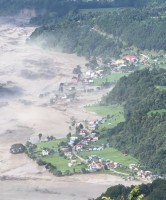
Rasuwa/Nuwakot/Dhading/Chitwan - A powerful and sudden flood in the Bhotekoshi River on Wednesday morning has caused significant damage in riverine areas from Rasuwa through Nuwakot and Dhading to Chitwan. Preliminary reports indicate damage to settlements, bridges, roads, hydropower projects, and physical infrastructure, including the Timure Customs Office, located around the river. A complete assessment of the human and physical losses is still underway.
The sudden breach of a temporary dam formed after the river was blocked has been identified as the preliminary cause of the flood, according to the Flood Forecasting Division. Citing information received from the Chinese side, the Division said that the lake formed at the river blockage point has not yet completely drained, meaning the risk around the Bhotekoshi and Trishuli rivers remains.
The Division has urged people living in riverine areas to stay away from the rivers and remain in safe locations until further notice.
According to hydrologist Sauhard Joshi of the Division, the exact location where the river was blocked has not yet been confirmed. The actual location of the blockage and the nature of the incident are expected to become clearer once new satellite imagery of the area is received.
He said that although the water flow appears to have decreased somewhat compared with the morning, the danger has not ended. Particularly in downstream areas, flowing water carrying rocks, soil, and other debris could cause further damage, making a high level of vigilance necessary.
Glacial Flood or Glacial Lake Outburst Also Considered a Possibility
According to geologist Shrikamal Dwivedi, information has been received that significant rainfall has occurred recently in the Langtang and northern Melamchi areas. He said that intense rainfall could have caused saturated soil in mountainous and Himalayan areas to suddenly slide downstream, while a landslide or glacier could also have blocked the river, forming a natural dam that subsequently breached.
Meteorologist Meen Kumar Aryal also said that although rainfall occurred in Tibet, it would not be appropriate to conclude that rainfall alone caused such a massive flood. According to him, possibilities such as a glacial lake outburst or the collapse of a temporary dam formed by a river blockage require detailed investigation.
A comprehensive geological, climatic, and satellite-based study of the affected watershed is necessary to confirm the actual cause of the incident.
How Do Glacial Floods Occur?
According to experts, extremely powerful glacial and debris-laden floods can occur in the Himalayan region through various processes, including the bursting of glacial lakes, rapid movement of glaciers and ice, intense rainfall over a short period in high-altitude areas, and major avalanches.
Such floods can carry huge quantities of rocks, soil, sand, and other debris at high speed along with the water, giving them a much greater destructive capacity than ordinary floods. Their impacts can extend dozens of kilometres downstream from the location where the flood originates.
In particular, if a large avalanche causes water to flow over the natural dam of a glacial lake, or if the dam itself weakens and collapses, a huge volume of water can move downstream within a short period. As the river carries additional sediment and debris, the flood can become even more destructive.
Experts have noted that in several major floods and debris-related disasters previously recorded in Nepal's Himalayan region, processes associated with glacial lakes, avalanches, intense rainfall, and glaciers have played a role.
Immediate Priority: Reducing the Risk
Although the exact origin and cause of the Bhotekoshi flood have yet to be conclusively determined, the preliminary information that the river remains partially blocked and has not completely opened indicates that the risk to downstream areas remains high.
Therefore, people living along the Bhotekoshi and Trishuli rivers, as well as those at settlements, roads, bridges, hydropower projects, and other structures in the river corridors, should immediately maintain a safe distance from the riverbanks.
Until further information is issued by the relevant authorities, people should not assume that the danger has passed simply because the river appears to be flowing normally. Particular caution is necessary because the water level could rise suddenly, debris-laden flows could occur, and any remaining natural obstruction upstream could breach again.
The actual cause of the event, the location of the river blockage, and the full extent of the damage will become clear only after further satellite imagery, field investigations, and official information from the relevant authorities are available.
#EcosphereNews #BhotekoshiFlood #Bhotekoshi #TrishuliRiver #NepalFlood #FloodAlert #FlashFlood #HimalayanFlood #GlacialLake #GLOF #ClimateRisk #DisasterRiskReduction #Nepal #FloodSafety #EnvironmentNews