Dhading, Nepal, June 17, 2026 - A pioneering agricultural initiative in Dhading is transforming traditional farmers into market-oriented agripreneurs, demonstrating how recognition, motivation, and entrepreneurial skills can drive sustainable agricultural growth and youth engagement in Nepal.
The Dhading Farm Enterprise Accelerator Initiative was inspired by a simple yet powerful question: if artists can gain national recognition through platforms such as Nepal Idol, why should agriculture-the backbone of Nepal’s economy-not receive similar respect, visibility, and appreciation?
With nearly 60 to 70 percent of Nepal’s population dependent on agriculture and around 40 percent of youth directly or indirectly engaged in the sector, agriculture remains a cornerstone of livelihoods. However, increasing youth migration has underscored the need to reposition farming as a viable, attractive, and aspirational profession. The initiative seeks to move beyond viewing farmers solely as producers and instead recognize them as entrepreneurs capable of building profitable and sustainable agribusinesses.
The program is implemented with technical support from Heifer International Nepal in partnership with Nilkantha Municipality and Siddhalek Rural Municipality, and facilitated by Action Nepal. Unlike conventional agricultural support programs that focus primarily on productivity, the initiative emphasizes market-oriented enterprise development. Built on Heifer Nepal’s systems-based approach, it equips farmers with business planning skills, climate-smart agricultural practices, financial literacy, and market engagement strategies.
More than 1,500 farmers participated in the Farmer Business School (FBS) training program. Following a rigorous selection process, 60 participants were shortlisted, 25 advanced to the next stage, and ultimately 10 farmers were selected through field evaluations conducted from April 7 to 9. The evaluation was carried out by a multi-stakeholder jury comprising representatives from Heifer International Nepal, Kathmandu University, Global IME Bank, and local governments.
The selected participants each received a seed grant of NPR 25,000 to support the development of their agricultural enterprises.
The selection process was guided by the M.A.I.R. framework-Motivation, Ability, Innovation, and Resources-alongside community validation to ensure transparency and inclusiveness. Participants reported significant improvements in farming techniques, stronger access to markets, increased income opportunities, and enhanced confidence in managing agricultural enterprises. Many have expanded their operations through land leasing, tunnel farming, and improved access to financial services.
The Accelerator Initiative also strengthens connections between farmers and key stakeholders, including local governments, financial institutions, universities, and private-sector actors. Through mentorship, digital tools, and market linkages, the program is helping participants transition from subsistence farming toward business-oriented agriculture focused on profitability, customer demand, and long-term growth.
Following their selection, participants underwent additional training in business communication and presentation skills. They also shared their entrepreneurial journeys with students in schools and colleges, generating considerable interest among young people and encouraging greater engagement in agriculture.
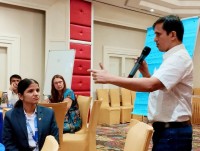
On June 17, 2026, the ten selected agricultural entrepreneurs presented their progress and achievements, marking the conclusion of this phase of the initiative. During the event, three farmer couples were formally recognized for their outstanding performance:
• Roshika Gurung & Pramod Gurung
• Ram Kumar Shrestha & Yub Kumari Shrestha
• Buddhi Prasad Burlakoti & Krishna Kumari Burlakoti
In addition, Bimala Koirala & Purna Prasad Koirala received special recognition for their strong potential and commitment to agricultural entrepreneurship.
All four recognized couples were awarded grants of NPR 50,000 to further strengthen their agribusiness ventures.
Stakeholders noted that this achievement represents not the end of the initiative, but the beginning of a broader effort to scale the model and inspire agricultural transformation across Nepal. The experience from Dhading highlights an important lesson: successful agricultural development depends not only on technical and financial support but also on motivation, recognition, and the cultivation of an entrepreneurial mindset among farmers.
As Nepal seeks to create sustainable livelihoods and reduce youth migration, initiatives such as the Dhading Farm Enterprise Accelerator are demonstrating how agriculture can evolve into a dynamic and rewarding enterprise sector capable of driving local economic growth and rural prosperity.
#Dhading #Agripreneurship #AgricultureNepal #FarmEnterpriseAccelerator #HeiferInternationalNepal #ActionNepal #NilkanthaMunicipality #SiddhalekRuralMunicipality #YouthInAgriculture #Agribusiness #FarmerBusinessSchool #ClimateSmartAgriculture #RuralDevelopment #AgriculturalTransformation #EcosphereNews