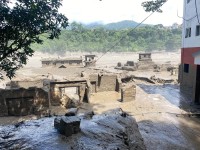
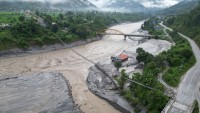
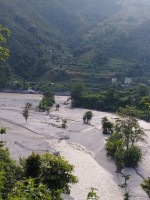
An aerial view shows damage after floods and landslides in Central Tapanuli, North Sumatra, on December 21, 2025. Photo Source: AFP
Kathmandu | Global Environment Desk
Environmental developments across continents this week reveal a world at a critical crossroads-where economic ambition, environmental governance, and community-led action are simultaneously shaping the planet’s future.
Economic Growth vs Environmental Limits
In Southeast Asia, fresh reporting highlights how extractive-led economic growth in Indonesia is intensifying environmental stress. Large-scale mining, deforestation, and land conversion-while driving short-term economic gains-are accelerating biodiversity loss, ecosystem degradation, and social conflict. The Indonesian case mirrors a broader challenge faced by many resource-rich developing nations: how to balance growth with ecological sustainability and social justice.
Global Governance and Major Powers
At the international level, attention has turned to China’s role in strengthening global environmental governance. As the world’s largest emitter and a major green technology investor, China’s engagement is increasingly seen as pivotal. Analysts emphasize that effective global environmental action will depend not only on national commitments but also on trust-building, transparency, and cooperative multilateral frameworks.
Meanwhile, the European Union has reaffirmed its commitment to science-based multilateralism, particularly in the areas of chemicals, waste, and pollution management. This signals a renewed push for evidence-driven global agreements at a time when environmental risks from hazardous substances and unmanaged waste are rising worldwide.
Policy Shifts and Institutional Change
In the United States, recent developments show how health policy reforms are now influencing environmental regulations, underscoring the growing recognition that environmental protection and public health are deeply interconnected. This policy convergence reflects a global trend: environmental degradation is no longer viewed as an isolated ecological issue but as a direct determinant of human well-being.
Community Action and Environmental Education
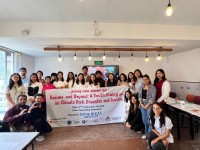
At the grassroots level, encouraging stories continue to emerge. Educational institutions in South Asia are actively promoting environmental conservation through awareness programmes, while interactive initiatives-from facility tours to youth engagement-are demonstrating how stewardship can be integrated into everyday practices.
In Northern Europe, the call for nominations for the Nordic Council’s Environment Prize 2026 highlights how innovation, youth participation, and local leadership remain central to advancing sustainability. Such recognition platforms play a crucial role in inspiring scalable solutions and cross-border learning.
Transparency, Accountability and Reporting
Environmental accountability is also gaining momentum through impact assessments and transparent reporting, particularly in sectors such as mining and infrastructure. At the same time, global environmental journalism-championed by independent platforms-is being recognized for its long-term role in holding power to account and amplifying voices from the frontlines of environmental change.
The Bigger Picture
Taken together, these developments illustrate a defining reality of our time:
Environmental challenges are global, but solutions must operate at every level-international, national, and local.
From forests in Southeast Asia to policy corridors in Europe and classrooms in South Asia, the direction humanity chooses now will determine whether development becomes destructive-or truly sustainable.
Ecosphere News will continue to track these interconnected stories, amplifying evidence-based dialogue and voices that matter, for a more informed and environmentally responsible global society.